Spezialbohrgetriebe: Engineering, Applications, Design, and Industrial Importance
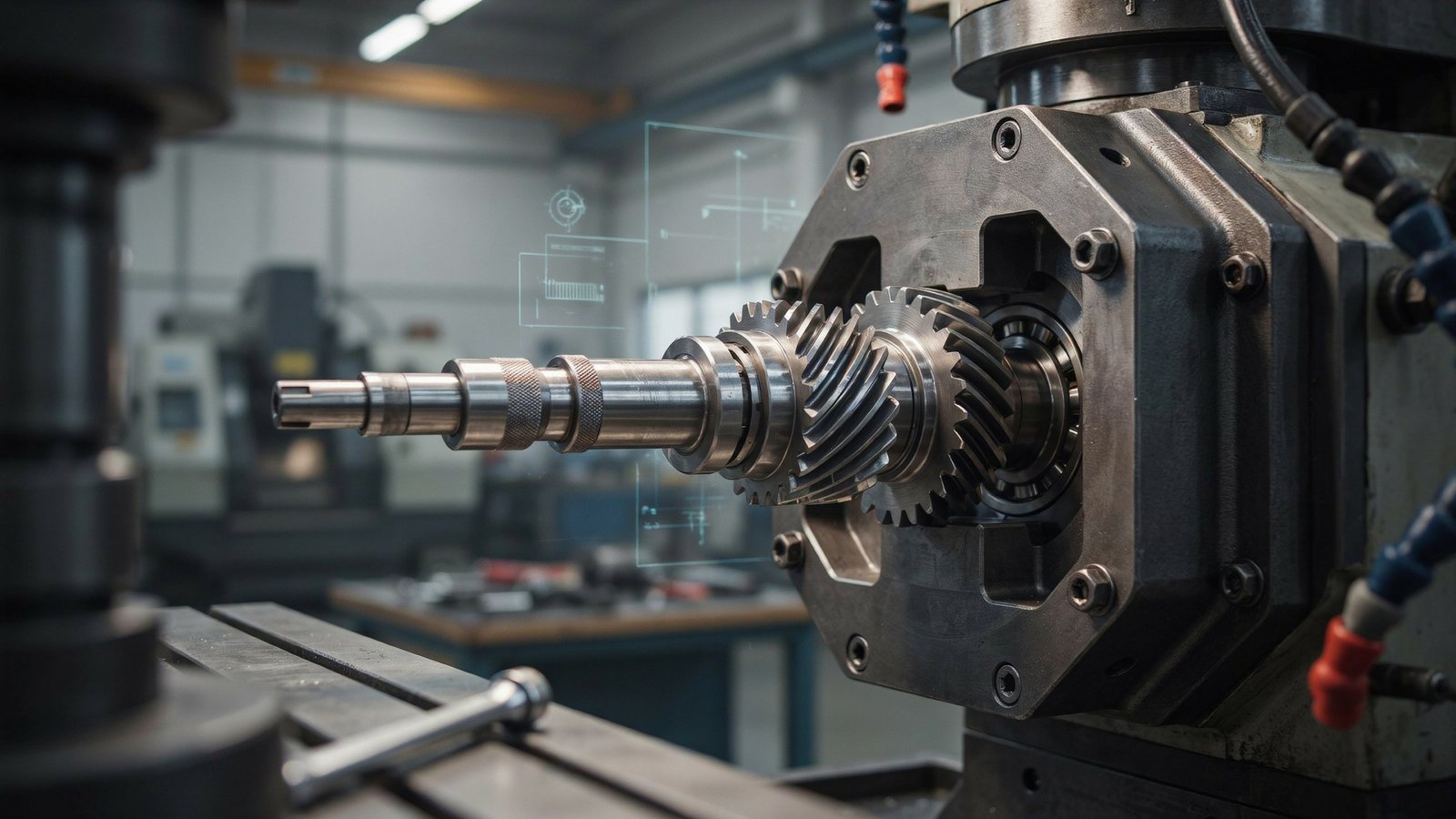
A spezialbohrgetriebe is a specialized gearbox engineered for drilling operations in which conventional transmission systems may not provide the required combination of torque, speed, precision, durability, and mechanical reliability. The term is German and can be understood broadly as “special drilling gearbox.” These systems are developed for demanding industrial environments where drilling equipment must operate under substantial mechanical loads while maintaining controlled rotational movement.
Unlike a standard gearbox designed for general machinery, a spezialbohrgetriebe is typically configured around the specific requirements of a drilling application. Those requirements may include high torque at low rotational speeds, controlled drilling speed, resistance to shock loading, compact installation dimensions, continuous operation, or compatibility with specialized drilling tools.
The importance of a spezialbohrgetriebe becomes particularly apparent in manufacturing, construction, mining, foundation engineering, geological exploration, and other technical fields. In these environments, the gearbox is not simply a component that transfers power. It forms a critical part of the drilling system and directly influences productivity, accuracy, equipment life, and operational stability.
What Is a Spezialbohrgetriebe?
At its most basic level, a spezialbohrgetriebe converts and transfers mechanical power from a motor or another drive source to a drilling mechanism. The gearbox adjusts the relationship between rotational speed and torque so that the drilling tool can operate within an appropriate performance range.
Electric motors, hydraulic motors, combustion engines, and other power sources often operate at speeds or torque levels that are unsuitable for direct connection to a drill spindle. A gearbox provides the necessary mechanical transformation.
A spezialbohrgetriebe can therefore perform several important functions:
- Increasing available torque
- Reducing or controlling rotational speed
- Transmitting power efficiently
- Managing mechanical loads
- Supporting controlled drilling movement
- Protecting drive components from excessive stresses
- Adapting a motor to a specialized drilling mechanism
- Providing the necessary shaft arrangement for the application
The exact configuration varies considerably. Some gearboxes are compact units intended for machine tools, while others are heavy-duty systems designed for demanding drilling equipment.
Spezialbohrgetriebe Biography Table
Because spezialbohrgetriebe describes an engineering component rather than a person, a conventional biography table is not appropriate. A technical profile table provides more useful information for readers.
| Technical Attribute | Description |
|---|---|
| German term | Spezialbohrgetriebe |
| English meaning | Specialized drilling gearbox |
| Primary function | Power transmission and speed/torque adaptation |
| Main application | Drilling machinery and specialized industrial equipment |
| Typical input | Electric, hydraulic, or mechanical drive |
| Main output | Controlled rotational power for drilling |
| Important characteristics | Torque, speed, durability, precision, efficiency |
| Common environments | Manufacturing, construction, mining, exploration |
| Key design consideration | Matching gearbox characteristics to drilling requirements |
| Maintenance priority | Lubrication, seals, bearings, gears, shafts, alignment |
This technical profile demonstrates why a spezialbohrgetriebe should be selected according to the complete operating environment rather than simply by looking at motor power.
How a Spezialbohrgetriebe Works
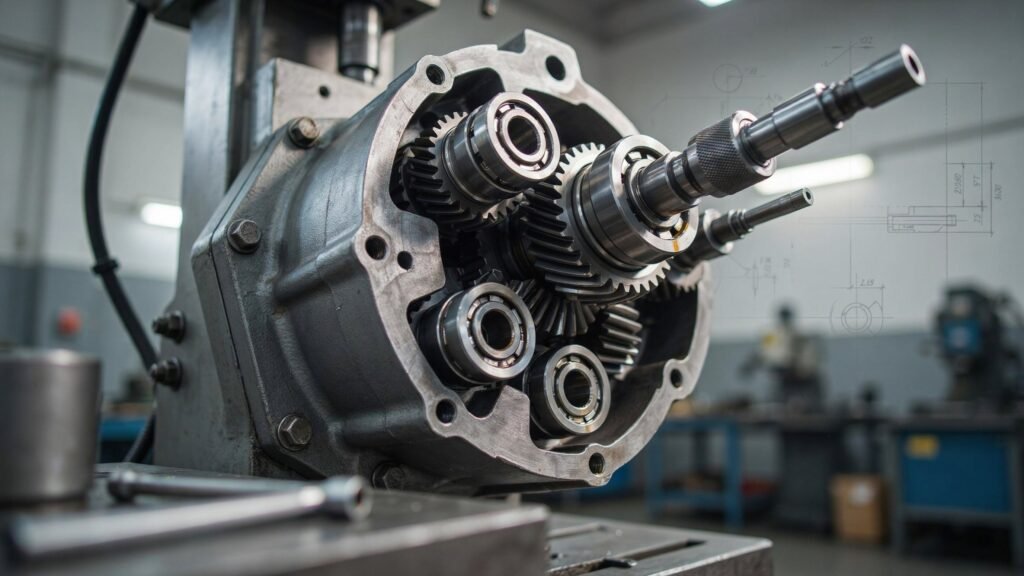
The operating principle of a spezialbohrgetriebe is based on controlled power transmission through gears and associated mechanical components.
A motor supplies rotational energy to the gearbox input shaft. The internal gear arrangement changes the rotational characteristics before transmitting power to the output shaft. Depending on the gear ratio, the output can rotate more slowly while producing greater torque, or it can rotate faster when the application requires increased drilling speed.
For example, a motor may operate efficiently at a relatively high rotational speed while a drilling tool requires substantially lower speed and significantly greater torque. The gearbox bridges this difference.
Inside the transmission, gears engage with one another to alter the mechanical relationship between input and output. Bearings support rotating shafts, seals help retain lubricant and prevent contamination, and the housing provides structural protection.
In more advanced designs, multiple gear stages may be used. This allows engineers to achieve larger transmission ratios while distributing mechanical loads across several stages.
The result is a controlled output that allows drilling equipment to perform consistently under demanding conditions.
Why Torque Matters in Drilling
Torque is one of the most important characteristics associated with drilling machinery. The drilling tool must overcome resistance from the material being penetrated. Depending on the application, this resistance can vary dramatically.
Hard metals, rock, concrete, composite materials, and dense geological formations can create substantial resistance. If the drive system cannot deliver sufficient torque, the drilling operation may become inefficient or unstable.
A spezialbohrgetriebe can provide the mechanical advantage required to increase output torque while reducing rotational speed. This makes it possible to use a relatively compact motor while still producing the rotational force required by the drilling process.
However, higher torque also creates greater mechanical stress. Gear teeth, shafts, bearings, couplings, and housing structures must therefore be designed to withstand the expected loads.
Speed Control and Drilling Performance
Torque alone does not determine drilling performance. Rotational speed is equally important.
Different materials and drilling tools require different operating speeds. Excessive speed may cause overheating, accelerated tool wear, vibration, or poor surface quality. Insufficient speed can reduce productivity and increase the time required to complete a drilling operation.
A spezialbohrgetriebe provides engineers with an effective way to establish an appropriate speed-to-torque relationship.
Some specialized systems may incorporate multiple ratios, allowing operators or automated machinery to select different operating conditions. Others are designed around a fixed ratio because the drilling process requires a highly specific output speed.
Modern industrial systems can also combine mechanical transmission with electronic motor control, creating a more flexible overall drive system.
Major Components of a Spezialbohrgetriebe
A specialized drilling gearbox typically contains several interconnected components. Their design and quality have a direct effect on reliability.
Gears
Gears are the primary elements responsible for changing speed and torque. Their tooth geometry, material, surface treatment, dimensions, and manufacturing precision all influence transmission performance.
Common gear arrangements can include spur, helical, bevel, planetary, or other specialized configurations.
Shafts
Input and output shafts transfer rotational power through the gearbox. They must tolerate torsional forces and bending loads while maintaining accurate alignment.
For demanding applications, shaft materials and surface treatments are carefully selected to improve fatigue resistance and service life.
Bearings
Bearings support rotating shafts and reduce friction. They must be selected according to rotational speed, radial loading, axial loading, temperature, and expected operating duration.
Bearing failure can cause vibration, excessive heat, noise, and eventually severe gearbox damage.
Housing
The gearbox housing provides structural support and protects internal components from dust, moisture, debris, and accidental mechanical impact.
A robust housing also helps maintain shaft alignment and contributes to thermal management.
Seals
Seals prevent lubricant from escaping and help prevent contaminants from entering the transmission.
This becomes especially important in drilling environments because dust, abrasive particles, moisture, and drilling debris can accelerate internal wear.
Lubrication System
Lubrication reduces friction and helps remove heat generated by gear and bearing operation.
The correct lubricant, quantity, viscosity, and replacement interval depend on gearbox design and operating conditions.
Applications of Spezialbohrgetriebe
The versatility of a spezialbohrgetriebe makes it relevant to many industrial applications.
Metalworking
In industrial manufacturing, specialized drilling machinery may need controlled rotational power to create precise holes in steel, aluminum, alloys, and other materials.
The gearbox helps maintain stable drilling conditions while supporting high productivity.
Construction
Construction equipment frequently operates under difficult conditions. Drilling systems used for concrete, foundations, anchors, and structural applications may experience significant shock loads.
A suitably engineered spezialbohrgetriebe can provide the torque and durability required for such work.
Mining
Mining applications can place extraordinary demands on mechanical equipment. Rock drilling requires powerful and reliable drive systems capable of operating for extended periods.
Gearboxes used in this environment must withstand vibration, dust, impact, and heavy mechanical loading.
Geological Exploration
Exploration drilling requires controlled mechanical performance because the drilling process may involve varying geological formations.
A specialized gearbox can help maintain predictable rotational behavior while the drilling equipment encounters changing resistance.
Industrial Machine Tools
Special drilling machines used in factories often prioritize precision, repeatability, and controlled operation.
In these environments, the spezialbohrgetriebe may be designed around specific spindle speeds, dimensions, and automation requirements.
Advantages of Using a Spezialbohrgetriebe
One of the principal advantages of a spezialbohrgetriebe is application-specific engineering.
A general-purpose gearbox may work adequately in many situations, but specialized drilling equipment often has requirements that cannot be satisfied by an off-the-shelf transmission.
A purpose-designed system can offer:
- Better torque management
- Appropriate rotational speed
- Improved mechanical efficiency
- Greater resistance to shock loading
- More suitable dimensions
- Better integration with existing machinery
- Improved operational reliability
- Greater control over drilling performance
Another major advantage is the possibility of optimizing the gearbox around the complete machine rather than treating the transmission as an isolated component.
Efficiency Considerations
Mechanical efficiency is increasingly important in industrial equipment. Energy losses inside a gearbox are influenced by gear geometry, bearing friction, lubrication, sealing, alignment, manufacturing accuracy, and operating conditions.
A well-designed spezialbohrgetriebe can reduce unnecessary losses by using efficient gear profiles, appropriate bearings, optimized lubrication, and accurate manufacturing tolerances.
Efficiency is not simply an energy-saving issue. Reduced losses can also mean lower heat generation. Lower operating temperatures can contribute to longer lubricant life and improved component durability.
For continuous industrial operations, even relatively small efficiency improvements can become significant over thousands of operating hours.
Materials and Manufacturing Quality
The reliability of a spezialbohrgetriebe depends heavily on material selection and manufacturing quality.
Gear components are commonly manufactured from engineering steels selected for strength, toughness, fatigue resistance, and wear performance. Heat treatment may be used to improve surface hardness while maintaining suitable internal toughness.
Precision machining is equally important. Incorrect tooth geometry, poor shaft alignment, or inadequate surface finishing can increase vibration and wear.
Modern manufacturing techniques allow gearbox components to be produced with increasingly precise tolerances. Quality control procedures can include dimensional inspection, hardness testing, surface analysis, gear contact evaluation, and operational testing.
Noise and Vibration
Noise and vibration are important indicators of gearbox condition.
A correctly manufactured and properly assembled spezialbohrgetriebe should operate within its intended vibration limits. Excessive vibration may indicate misalignment, worn bearings, damaged gears, inadequate lubrication, imbalance, or another mechanical problem.
Reducing vibration is particularly important in precision drilling because unwanted movement can influence hole quality and tool life.
Engineers therefore consider gear tooth accuracy, bearing selection, housing rigidity, shaft dynamics, and assembly tolerances when designing specialized transmissions.
Maintenance Requirements
Regular maintenance can significantly extend the service life of a spezialbohrgetriebe.
A practical maintenance program may include:
- Checking lubricant condition.
- Monitoring lubricant levels.
- Inspecting seals for leakage.
- Listening for unusual operating noise.
- Monitoring vibration.
- Checking operating temperature.
- Inspecting shafts and couplings.
- Examining bearings during scheduled servicing.
- Looking for abnormal gear wear.
- Verifying alignment after major maintenance work.
Maintenance intervals should always be established according to the manufacturer’s engineering specifications and the actual operating environment.
A gearbox operating in a clean factory may require a different maintenance strategy from one exposed to abrasive dust, moisture, and continuous shock loading.
Common Causes of Gearbox Failure
Even a high-quality spezialbohrgetriebe can fail when operating conditions exceed its design limits.
Common causes include overload, inadequate lubrication, contamination, poor alignment, excessive temperature, bearing deterioration, gear tooth damage, shaft fatigue, and improper installation.
Overloading is particularly dangerous because repeated excessive torque can create fatigue damage even when the gearbox continues to operate normally for some time.
Lubrication problems are another major concern. Insufficient lubricant can increase friction and temperature, while contaminated or unsuitable lubricant can accelerate wear.
Correct installation is equally important. A precisely engineered gearbox can still perform poorly if the shafts are misaligned or the mounting structure lacks sufficient rigidity.
Selecting the Right Spezialbohrgetriebe
Selecting a gearbox should begin with the drilling application’s actual requirements.
Important factors include input power, input speed, required output speed, output torque, duty cycle, shock loading, installation space, environmental conditions, shaft configuration, lubrication requirements, and expected service life.
Engineers should also consider whether the gearbox must support continuous operation or intermittent drilling cycles.
The ideal spezialbohrgetriebe is therefore not necessarily the largest or most powerful option. It is the transmission whose characteristics most closely match the application’s mechanical requirements.
The Role of Custom Engineering
Customization is particularly valuable when standard gearbox dimensions or ratios cannot satisfy the needs of a specialized machine.
A custom spezialbohrgetriebe may be designed with a particular mounting pattern, shaft configuration, gear ratio, housing geometry, or output interface.
Custom engineering can also address environmental challenges. For example, a gearbox intended for a harsh outdoor drilling environment may require enhanced sealing and corrosion protection.
In automated manufacturing, integration with sensors and control systems may also influence gearbox design.
Spezialbohrgetriebe and Modern Industrial Automation
Industrial automation is changing how drilling equipment is designed and operated.
Modern machines can use sensors to monitor torque, temperature, vibration, speed, and other operating parameters. These measurements can provide valuable information about the condition of the transmission.
A spezialbohrgetriebe integrated into a digitally monitored machine can therefore become part of a broader condition-monitoring system.
Predictive maintenance approaches can identify changes in operating behavior before they develop into major failures. This can reduce unexpected downtime and help industrial operators plan maintenance more efficiently.
Future Developments
The future of specialized drilling gearboxes is likely to involve continued improvements in efficiency, durability, precision, compactness, and monitoring.
Advanced materials and improved heat-treatment techniques may help manufacturers increase load capacity without dramatically increasing gearbox dimensions.
Manufacturing technologies are also enabling increasingly accurate gear production. Improved computational modeling allows engineers to analyze stresses, thermal behavior, vibration, and fatigue before physical prototypes are produced.
At the same time, smart sensors and digital monitoring systems are creating opportunities for more intelligent maintenance strategies.
The spezialbohrgetriebe of the future may therefore be more compact, more efficient, more closely integrated with electronic control systems, and better equipped for real-time condition monitoring.
What Makes a High-Quality Spezialbohrgetriebe?
A high-quality spezialbohrgetriebe is defined by more than its nominal power rating.
It should provide a suitable balance of torque, speed, efficiency, structural strength, precision, thermal performance, and service life. The transmission must also be compatible with the drilling tool, motor, mounting structure, and working environment.
Engineering quality begins with correct specifications and continues through material selection, gear design, machining, heat treatment, assembly, lubrication, testing, and maintenance.
For demanding drilling operations, these details can determine whether equipment delivers consistent productivity or becomes a source of repeated downtime.
Frequently Asked Questions
What does spezialbohrgetriebe mean?
Spezialbohrgetriebe is a German engineering term that generally refers to a specialized drilling gearbox. It describes a transmission designed to adapt mechanical power for a particular drilling application.
What is the primary purpose of a spezialbohrgetriebe?
Its primary purpose is to transfer mechanical power while adjusting speed and torque to meet the requirements of a drilling system.
Where are specialized drilling gearboxes used?
A spezialbohrgetriebe can be used in manufacturing machinery, construction equipment, mining systems, geological drilling equipment, foundation machinery, and other specialized industrial applications.
Why is torque important in drilling?
Torque determines the rotational force available to overcome resistance from the material being drilled. Harder materials often require greater torque, particularly at controlled rotational speeds.
Can a spezialbohrgetriebe be customized?
Yes. Specialized gearboxes can be engineered around particular speed, torque, dimensions, mounting, shaft, environmental, and operational requirements.
What causes gearbox failure?
Common causes include excessive loads, insufficient lubrication, contamination, overheating, bearing wear, gear damage, misalignment, and improper installation.
How can gearbox life be extended?
Appropriate lubrication, regular inspection, correct alignment, controlled loading, proper installation, and timely replacement of worn components can help extend gearbox service life.
Is a spezialbohrgetriebe only used for drilling?
Although its principal purpose is associated with drilling machinery, specialized transmissions can be adapted for other applications requiring carefully controlled torque and rotational speed.
Why are bearings important?
Bearings support rotating shafts, reduce friction, and help maintain accurate shaft positioning. Bearing deterioration can affect vibration, temperature, efficiency, and overall gearbox reliability.
What should engineers consider when selecting one?
Engineers should evaluate power, speed, torque, duty cycle, shock loads, environmental conditions, mounting dimensions, shaft configuration, lubrication, expected service life, and compatibility with the complete machine.
A Technical Perspective Worth Remembering
The most useful way to understand a spezialbohrgetriebe is to view it as the mechanical interface between a power source and a demanding drilling process. Its job is not merely to reduce speed or increase torque. It must transform available mechanical energy into a form that the drilling system can use safely, efficiently, and consistently.
That distinction explains why specialized gearbox engineering remains important even as motors, controllers, sensors, and automation systems become increasingly sophisticated. Electronic control can regulate a motor, but the physical transmission still has to withstand the forces generated by the drilling process.
When gear geometry, materials, lubrication, bearings, housing design, shaft alignment, and operating conditions are considered as one integrated engineering system, a spezialbohrgetriebe can become one of the most dependable elements of a modern drilling machine.
Leave a Reply